Grass Master – Cutting Game
- 4.7
- Rating
- 1.00M
- Installs
- Free
- Price

 Analysis by App-foxy
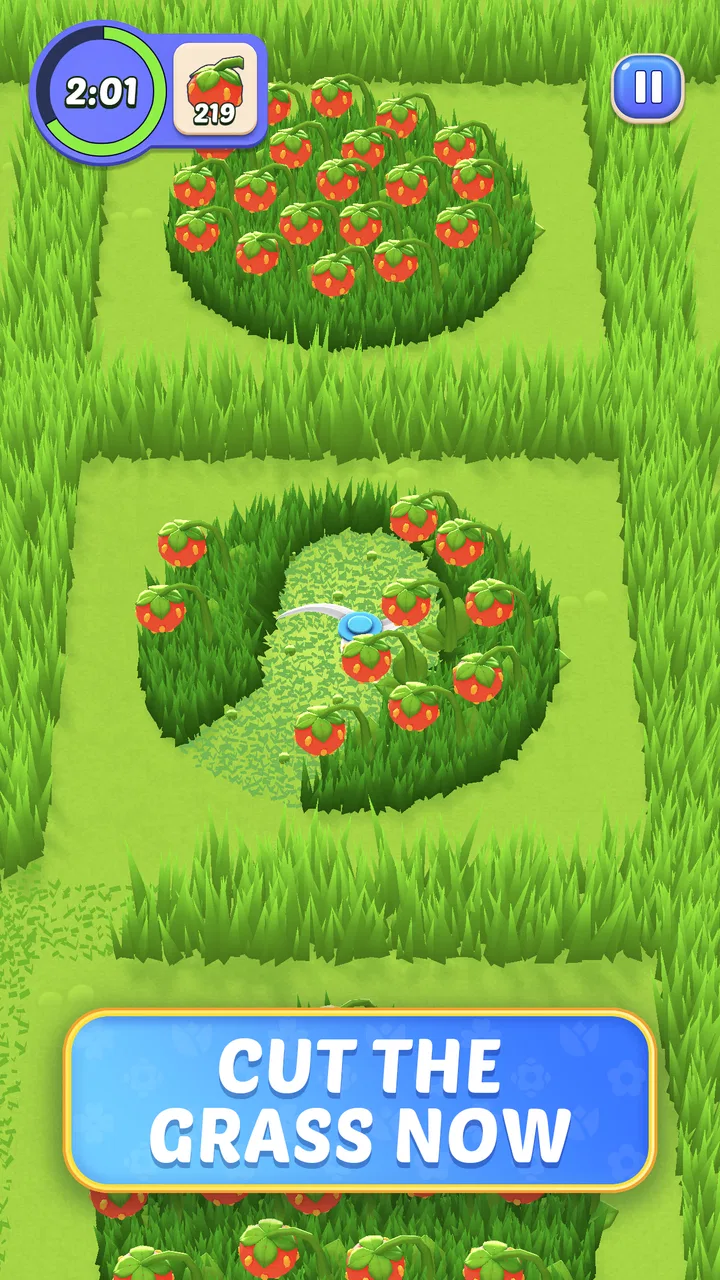
I tried Grass Master – Cutting Game as the kind of quick puzzle game you can pass around at home when someone wants a short, low-pressure distraction. Its idea is easy to understand: guide a mower through grass and clear the area as neatly as possible. That simplicity is the main reason it works. I did not need a tutorial-heavy introduction or a long explanation before starting, and the satisfying visual result gives each small task a clear purpose.
This is a free game from SayGames Ltd in the puzzle category, aimed at Everyone. It has reached over 50 thousand installs and holds a 4.7 average from hundreds of ratings, which fits my impression that its straightforward format is easy for a broad audience to pick up. The current release is version 1.4.0, and it runs on Android 8.0 or later. There are optional in-app purchases, ranging from $0.99 to $99.99 per item, so the free entry point is useful, but I would still keep an eye on purchase settings if the game is being used on a shared device.
How Grass Master fits into shared household play
I find Grass Master easiest to share when everyone treats it as a small planning challenge rather than a race to finish. A useful way to keep turns fair is to let the person holding the device make the final route choice, while others offer one suggestion at a time. That keeps the puzzle social without taking away the satisfaction of solving it, and it makes the next section’s turn-taking approach feel natural.
You May Also Like

 Blood Strike: 2.5 Anniversary
Blood Strike’s Loadouts Turn Every Drop Into a Tactical Gamble
A close look at Blood Strike’s custom loadouts: how fast access to signature weapons reshapes its battle royale rhythm, rewards preparation, and narrows the gap between fights.

 Pandora - Music & Podcasts
Pandora’s Music Is Easy to Start, but Harder to Recover
Pandora’s strength is its low-effort path from a seed to a station. Its weak spot is how much confidence it asks you to place in connection, setup, and quiet recovery.

 8 Ball Pool
 Is Built on Rivalries, Rematches, and Routine
A close look at the rivalries, rematches, shared routines, and unanswered safety questions that turn a quick pool match into a persistent mobile community.

 Samsung Music
’s Quiet Strength Is Playing What You Already Own
Its reach comes less from spectacle than from dependable access to a personal library. That simplicity is both the app’s strongest retention engine and its ceiling.

 AccuWeather: Weather Radar
AccuWeather Review: A Quick, Clear Forecast for Everyday Decisions
For everyday plans, the best forecast is the one you can understand quickly. AccuWeather makes rain timing, radar, and local conditions easy to act on, with a few trade-offs.

 Hill Climb Racing
Why Hill Climb Racing Still Turns Crashes Into One More Run
A tiny car, a bumpy hill and one more upgrade: Hill Climb Racing keeps resurfacing because its simple chaos makes every near-miss feel personal.
More From Our News Desk



A simple game to pass between people
In my experience, the best shared-device games are not necessarily multiplayer games. Sometimes the useful format is one where each person takes a turn, solves a level, and hands the phone back. Grass Master suits that kind of informal play because the central action is immediately readable. One person can demonstrate the basic movement, while another can take over without needing to learn a complicated control scheme.
I can imagine it working well during a short break at home: one person finishes a puzzle while waiting for dinner, a child asks to try the next one, and an adult takes over when a layout becomes less obvious. The game has a naturally visible goal, so the person watching can understand what is happening without interrupting constantly. That makes it more suitable for a sofa, kitchen, or waiting-room setting than a game that demands headphones, a full-screen explanation, or a long uninterrupted session.
The lawn-mowing theme also gives the puzzles a calmer identity than many fast reaction games. The appeal comes from planning a route and seeing the grass disappear, not from shooting, racing, or competing against another player. For a household that wants something gentle and easy to explain, that difference matters. It is especially useful when several people have different gaming experience levels.
What the game actually asks you to think about
The apparent simplicity should not be confused with mindless tapping. The interesting part is deciding how to cover the available grass without wasting movement or leaving awkward sections behind. I found myself looking at the shape of an area before moving, rather than immediately dragging around and hoping the mower would sort everything out.
A practical tip is to pause for a moment at the beginning of a level and identify narrow corners, edges, and any section that could become inaccessible after an early turn. In a shared setting, this also creates a natural conversation: one player can suggest a route, while the person holding the device decides whether to follow it. That makes the game more cooperative in spirit even when the play itself is centered on one screen.
Another useful habit is to treat failed attempts as route experiments instead of mistakes. If a path leaves one patch of grass behind, the next attempt can begin with that problem in mind. This is a better fit for children or casual players than a puzzle game where one wrong move immediately feels punishing. It also gives adults a reason to keep playing beyond the first novelty of cutting grass.
Why the visual payoff matters
The clearing effect is more important than it may sound. A puzzle can feel abstract when the result is only a number or a completed icon. Here, the changing lawn provides direct feedback: the messy space becomes orderly as the route succeeds. I found that visual transformation helped me understand whether a move was useful before I had fully solved the level.
That feedback can make the game appealing to someone who does not normally choose puzzle apps. A person may not be interested in grids, word clues, or traditional logic problems, but still enjoy the physical idea of cutting an overgrown patch cleanly. Compared with a standard match-style puzzle, Grass Master feels more spatial and task-focused. Compared with a pure maze, it adds a stronger sense of completion because the route changes the environment.
Setting boundaries before handing over the device
The game is free to start, which makes it convenient for a shared phone or tablet. However, the presence of optional purchases means I would not hand over a device with unrestricted buying access and assume everything is fine. The purchase range extends from $0.99 to $99.99 per item, so the sensible household approach is to use the device’s existing purchase protections and make sure the person playing knows that free access does not necessarily mean every item is free.
I would also decide in advance whether the device is being used for a single short turn or an open-ended session. That boundary is not a feature of Grass Master; it is a practical rule for the household. The game’s bite-sized structure makes it easy to say “one more level,” and that can quietly turn a five-minute break into a much longer session. Agreeing on a stopping point before play avoids arguments, especially when several people are waiting for a turn.
On a shared device, I recommend keeping the game’s progress associated with the person who normally plays it, rather than assuming that every player will have a separate profile. The important point is not to promise account separation that the game may not provide. If several people care about individual progress, they should agree whose device or play session is the main one. For casual turns, this is not a serious issue; for a household where everyone wants personal records, it is worth discussing before starting.
Coordinating turns without making the game complicated
Grass Master is easiest to share when the group treats it as a turn-based puzzle rather than a contest. I would let one player inspect the level, allow another to suggest the opening direction, and then give control back to the person whose turn it is. That small routine prevents the common problem where several hands reach for the screen and nobody knows which move was intended.
There is also a useful distinction between advice and control. Watching someone else solve a route can reveal a better idea, but taking the device away every time the player hesitates removes the satisfaction of solving it. I found the game more enjoyable when suggestions were limited to questions such as “What happens if you start from the edge?” rather than direct instructions. This makes it suitable for an adult and child to play together without turning the adult into the actual player.
For older children or siblings, the game can become a quiet coordination exercise. One person can plan while another handles the controls, then they can swap roles. That arrangement is more interesting than simply passing the phone after every level because it gives both players something to do. It also exposes a trade-off: a player who wants complete personal control may prefer to play alone, while a household looking for light cooperation can make the planning part social.
Age context and trust
The Everyone rating reflects the game’s approachable presentation and non-violent mowing theme. I would consider it a reasonable option for a child who enjoys simple puzzles, but an age label should not replace ordinary supervision. The main concerns in a family setting are likely to be screen time, accidental purchases, and whether the child understands that optional items can cost real money.
For younger players, I would play the first few sessions together. That gives them time to learn the route-planning idea and gives the adult a chance to see how the child responds when a solution is not immediate. Some children will enjoy trying different paths; others may become frustrated when a careless turn forces a restart or leaves a difficult section. The game is a better choice for the first group, unless the second group enjoys experimenting without needing to finish every attempt.
For older children and adults, the appeal is less about learning the controls and more about optimizing decisions. A player who likes neat solutions may keep returning to improve a route, while someone who wants a story, characters, or a large world may lose interest quickly. I would not choose this as a replacement for a deep strategy game. Its strength is the compact puzzle loop, not narrative development or long-term character progression.
Where it stands beside familiar puzzle alternatives
Compared with match-three games, Grass Master offers less emphasis on combinations and more emphasis on spatial planning. You are not waiting for a board to generate a lucky arrangement; you are responsible for the path you take through the lawn. That makes the outcome feel more connected to your decisions, although it may seem less exciting to players who prefer cascading effects and constant visual fireworks.
Compared with maze games, the mowing theme gives each route a visible purpose. A maze usually asks you to reach an exit, while this game makes coverage the central concern. That difference changes how I approached levels: instead of simply searching for a destination, I thought about the order in which sections should be cleared. Players who enjoy tracing paths but want a stronger sense of completion may prefer this format.
Compared with traditional logic puzzles, the learning curve feels lighter, but the game may also offer less depth for someone seeking a serious mental challenge. Its best use is as a short reset between demanding tasks, a casual activity for a shared screen, or an accessible introduction to route-based puzzle thinking. If you want elaborate rules, extensive customization, or a campaign built around story, another puzzle game would be a better match.
Small frictions worth knowing before installing
The straightforward concept can become repetitive if you play for a long stretch. Cutting grass is satisfying at first, but the basic action does not have the variety of a puzzle game that constantly introduces new mechanics. I preferred it in short sessions, where the clean-up effect remained rewarding instead of becoming routine.
The free model is another point to consider. I could begin without paying, which lowers the barrier to trying it, but optional purchases mean the game is not the same as a completely purchase-free app. Anyone installing it for a child should handle the payment boundary first. Anyone installing it for themselves should decide whether the free experience is enough before spending money on extras.
Device sharing can also blur progress and expectations. If one person restarts a level, another may feel that their solution was lost; if several players use the same installation, it may be unclear who is responsible for the current state. I would avoid presenting the game as a multi-account family platform. It works better as a single-player puzzle that happens to be easy to pass around.
Who should choose it, and who should skip it
I would recommend Grass Master to someone who likes tidy visual goals, short puzzle sessions, and games that can be explained in a few seconds. It is particularly suitable for households that want a calm shared activity without competition, complicated controls, or a strong age barrier. It also works for adults who want something more thoughtful than a reflex game but less demanding than a long logic session.
I would skip it if your priority is online interaction, a substantial story, personal profiles for every household member, or a deep progression system. I would also look elsewhere if you dislike repeating a central action or if optional purchases are a deal-breaker even when the initial download is free. The game’s appeal depends on enjoying the route itself and the visual satisfaction of clearing the lawn; without that, there is not much else to carry the experience.
On Android 8.0 or later, the current version is 1.4.0, so compatibility is straightforward for devices that meet that requirement. I would still install it on the device that will actually be shared and test the first session there, because comfort, screen size, and the way people hold the device matter more for this kind of hands-on puzzle than a feature checklist suggests.
My household verdict
After spending time with it, I see Grass Master – Cutting Game as a focused casual puzzle rather than a game designed to become the center of a household’s entertainment. Its strongest quality is the clean relationship between action and result: plan a route, cut the grass, and watch the space become orderly. That makes it easy to recommend for short, shared turns and for players who enjoy visual progress.
I would use it with clear boundaries around turns, screen time, and purchases. I would also be honest with younger players about whose progress is being used, since a shared installation should not automatically be treated as a set of separate personal accounts. With those expectations in place, the game creates a pleasant little routine: one person studies the lawn, another suggests a route, and the player makes the final move.
My final view is positive but specific. This is not the right choice for depth, storytelling, or competitive multiplayer, and its core action may wear thin during long sessions. For a free puzzle that fits a quick break and can be understood by a wide age range, though, it does its job well. If the idea of leaving a lawn perfectly cleared sounds more satisfying than matching colored tiles or escaping a maze, I think it is worth trying.
FAQs for Grass Master – Cutting Game
01What is the main objective of Grass Master – Cutting Game?
Grass Master – Cutting Game is a casual simulation game where the primary goal is to efficiently cut grass and maintain a virtual lawn. Players navigate various levels, each presenting unique challenges and obstacles, to achieve the neatest and most precise grass cut possible. The game combines strategy with relaxation, offering a satisfying experience for all ages.
02Are there any in-app purchases or ads in Grass Master – Cutting Game?
Yes, Grass Master – Cutting Game includes both in-app purchases and advertisements. Players can choose to buy premium items or power-ups to enhance their gameplay experience. Additionally, ads may appear between levels or during certain game actions, although they can often be removed through a one-time purchase.
03What devices are compatible with Grass Master – Cutting Game?
Grass Master – Cutting Game is available on both Android and iOS platforms. It requires a minimum of Android 5.0 or iOS 10.0 to run smoothly. The game is optimized for both smartphones and tablets, ensuring a seamless experience across various devices. Make sure your device meets these requirements before downloading.
04Is Grass Master – Cutting Game suitable for children?
Grass Master – Cutting Game is designed to be family-friendly, with simple controls and gameplay that appeal to players of all ages. There is no inappropriate content, making it suitable for children. However, parents should be aware of in-app purchases and supervise accordingly to prevent accidental spending.
05How can I improve my skills in Grass Master – Cutting Game?
To excel in Grass Master – Cutting Game, practice is key. Focus on mastering the controls and understanding each level's unique layout. Watching short tutorial videos or reading player tips online can also provide strategies for better performance. Lastly, consider upgrading tools through in-game purchases to enhance your cutting efficiency.
Pros
- Engaging and addictive gameplay.
- Intuitive controls for easy play.
- Visually appealing graphics.
- Regular updates with new levels.
- No intrusive ads during gameplay.
Cons
- Limited customization options.
- Can become repetitive over time.
- Requires internet for full features.
- Occasional lag on older devices.
- In-app purchases can be costly.

Grass Master – Cutting Game
Gallery